“At the end of the day” can close an argument or describe the hour when a shift finishes. Those readings share the same words. A dictionary can name the idiom; a remembered conversation can suggest its tone. A corpus—a deliberately assembled body of recorded language—lets a reader ask a different set of questions. In which kinds of text does the phrase appear? What surrounds it? How often does the idiom, rather than the literal time expression, occur in the material actually collected?
The answer begins with the collection itself. The British National Corpus contains roughly 100 million words of British English, mostly written material with a smaller portion transcribed from speech. Its texts were assembled in the early 1990s and the XML edition was released in 2007. A search there is evidence about that sampled period and variety of English. It is not a live vote by everyone speaking English today. That boundary makes the findings more useful: one knows what was counted.
A count is the start of the reading
In an original study using the BNC, José L. Oncins-Martínez reported 760 occurrences of “at the end of the day,” almost all used figuratively. Of those, 332 appeared in the corpus's spoken section. The number is more interesting when set beside the size of that section: Oxford's reference guide says recorded speech makes up about ten percent of the corpus. A substantial share of the phrase's occurrences thus came from a relatively small share of its words. The study's count belongs to its search and that edition of the corpus; it is not an eternal tally for the phrase.
The comparison is why corpus researchers use rates as well as raw totals. A phrase occurring 300 times in ten million words is far denser than one occurring 400 times in ninety million. Search results reported per million words make unlike sections easier to compare. But even a normalized rate depends on how a corpus was sampled. The BNC's design documentation explains why speech was expensive to record and transcribe, and why the project combined conversations recorded by selected speakers with speech from settings such as meetings, broadcasts and lectures. “Spoken English” in the database has a documented construction. It is not every unrecorded conversation in Britain.
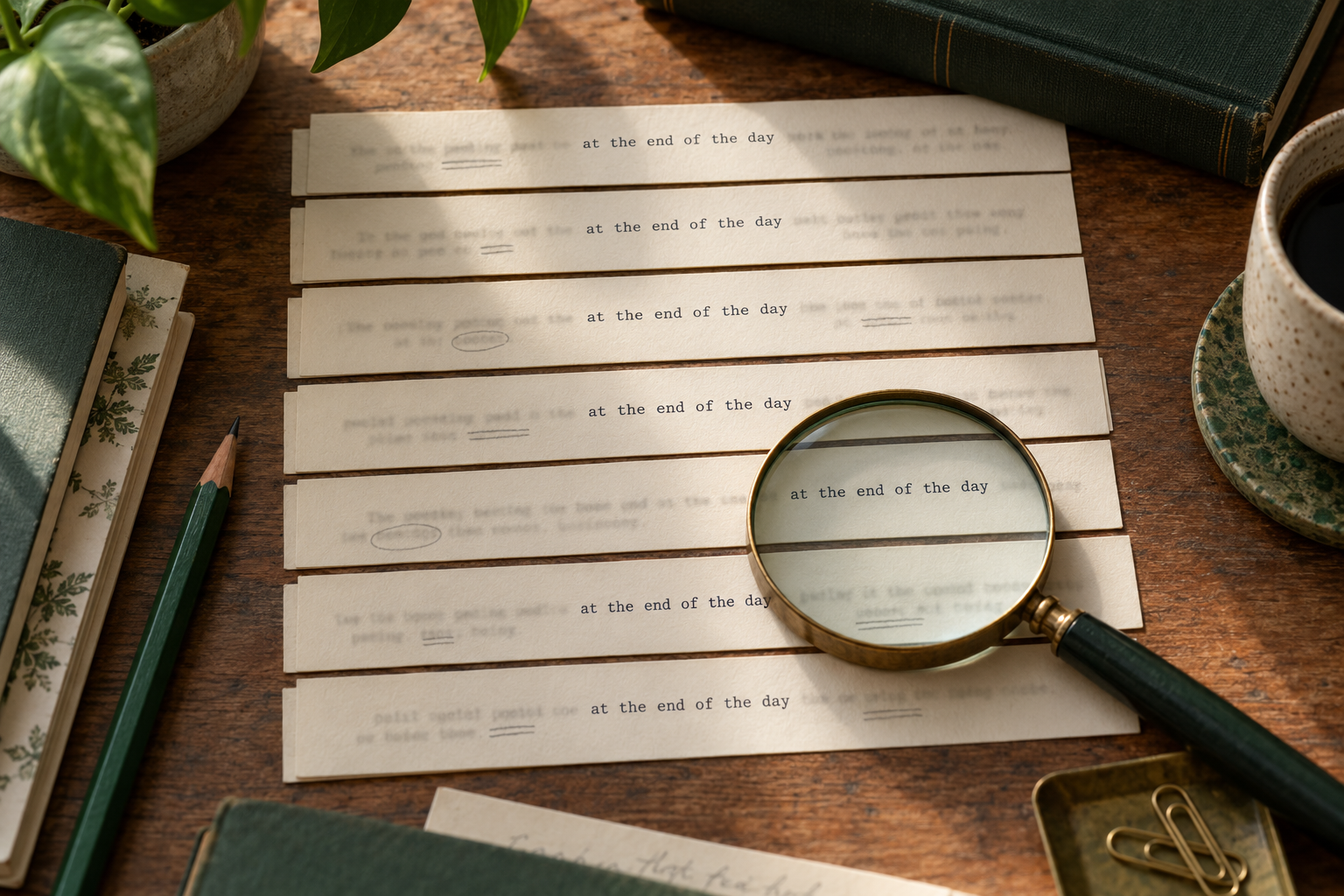
The raw string also needs to be read in context. A list of search hits can place the phrase in the middle of each sentence, with words on either side. In one setting the phrase might be a time marker; in another, a speaker may use it to announce a conclusion. Oncins-Martínez inspected the surrounding text to distinguish the two readings before describing the count. Without that step, a computer has located matching characters, not established what each speaker meant. A phrase can be common as a sequence of words while its meanings have very different distributions.
Neighbours give a phrase a job
The words around a phrase can reveal its role in an argument. If an expression often follows a concession or introduces a final judgment, the surrounding sentences help explain why it is used there. If it sits beside closing time, the literal reading becomes more plausible. These are clues that require examples, not an automatic verdict from a frequency table. The BNC reference guide records the text type, date and other metadata with its samples so an occurrence can be read alongside more than a naked word count.
Oncins-Martínez used the English phrase for another question: whether the similar Spanish expression al final del día had taken on a figurative use under English influence. His corpus comparison examined English BNC evidence alongside older and contemporary Spanish collections, looking at both occurrences and contexts. The older Spanish examples he reported were literal; some later ones had a summarizing function. He argued for a calque in those later cases. A corpus can make a proposed language change inspectable, but the source itself is an analysis, not proof that every modern speaker borrowed the phrase personally or that one example establishes a direction of influence.
The same method extends to less conspicuous combinations. Researchers ask which words regularly appear near a target, which grammatical structures carry it and whether it favours conversation, fiction or formal writing. A database can count those patterns quickly. Reading a selection of actual passages checks whether the pattern is a meaningful habit or a search artefact. The work moves back and forth between many examples and individual sentences; neither scale is enough on its own.
A larger corpus can answer a different question
A newer corpus may be useful if the question moves beyond British English of the early 1990s. The builders of the Corpus of Contemporary American English describe a 2020 edition with about a billion words spread among speech transcripts, fiction, magazines, newspapers, academic writing, blogs, other web pages and screen subtitles. That scale can bring rare phrases into view and permit comparisons among types of material. Its American focus and 1990–2019 date range also change what it can support. A hit in a subtitle is not identical to a recorded conversation, and a web page may have a different editorial history from a novel.
It would be misleading to put 760 BNC hits beside a raw count from COCA and declare that one country loves the phrase more. The corpora differ in size, date, geography and mixtures of text. Even normalized counts need comparable slices: the same or similar years, a stated kind of speech or writing, and a check that the search retrieves the same form and meaning. If the question is change over time, a dataset with documented period coverage is needed; the BNC alone cannot track 2026 usage because it stopped adding texts decades ago. The BNC's own overview calls it a synchronic sample of late twentieth-century British English.
Size is not the only virtue. The Open American National Corpus makes a smaller collection of about 15 million words openly available with automatic annotations. Its MASC subset is smaller still—about half a million words—but has manually produced or checked layers of annotation across nineteen genres. That trade can matter when a researcher needs to inspect a word's grammatical or semantic role rather than find every available hit. The BNC too uses automatic part-of-speech tagging, as its reference guide explains. A search that depends on a tag inherits the tagging system's decisions and errors; it needs the same scrutiny as a search that depends on spelling.
The resulting claim should be as narrow as the evidence. A corpus can show that a phrase occurred in specified samples, which contexts it favoured there, and whether a proposed pattern survives comparison with another defined set of texts. It cannot show every unrecorded use, and its count alone does not decide whether the phrase is graceful, tired or useful in a sentence being written now. “At the end of the day” may be a habit worth cutting in one paragraph and the exact voice a speaker uses in another. The corpus does not edit the paragraph. It gives the editor a better account of what the words have been doing elsewhere.
A thought worth keeping?