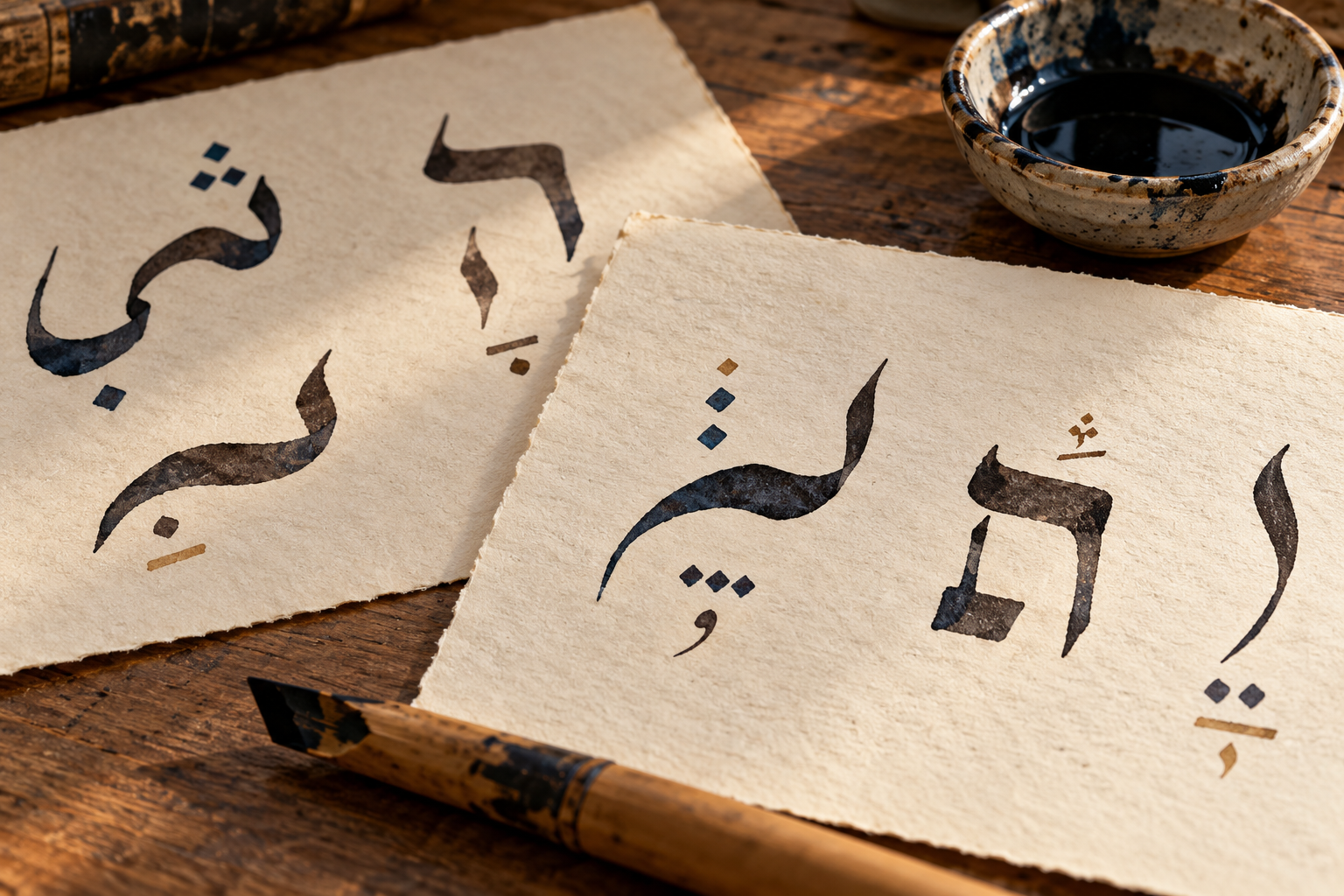
The Arabic letters كتب can be read kataba, “he wrote,” or kutub, “books.” Add the small vowel marks and the alternatives part company: كَتَبَ and كُتُب. In an ordinary unmarked sentence, the reader does not stare at three consonants and guess at random. The surrounding words, the familiar shapes of words, and knowledge of Arabic grammar narrow the possibilities.
This is one way a writing system can be precise without recording every sound in every word. It assigns some information to letters, makes other information available through optional marks, and expects readers to bring the language they know to the page. The choice has consequences: it can make a familiar line quick to scan while leaving a new or isolated word harder to pronounce.
What the page leaves unmarked
Arabic is often called an abjad, a system whose ordinary letter sequence emphasizes consonants. That description needs care. Standard Arabic uses letters for long vowels as well as consonants. Its short vowels can be shown by small marks above or below letters, but those marks are commonly omitted in ordinary prose. A study of beginning Arabic readers gives the very example of كتب as kataba or kutub and distinguishes the three long-vowel letters from the optional short-vowel signs. Saying that Arabic “writes no vowels” erases an important part of how its spelling works.
The optional layer contains more than vowels. The Unicode Standard's account of Arabic and Hebrew distinguishes Arabic harakat, the short-vowel marks, from signs such as shadda, which indicates a doubled consonant. It also distinguishes those optional signs from the dots that separate many Arabic consonant letters. A dot belonging to a letter is not a vowel mark that a writer may simply discard in normal typeset Arabic. The page is selective, but its selectivity has rules.
Hebrew provides a related, distinct case. Vowel points called nikkud can be placed around the letters, yet most ordinary Modern Hebrew text is unpointed. The Academy of the Hebrew Language describes two standard written forms, pointed and unpointed. It explains that unpointed spelling often uses vav and yod as vowel indicators more widely than pointed spelling does. Removing the points therefore does not always mean taking a fully pointed word and leaving exactly the same letters behind. The spellings themselves can differ.
These examples show why “missing vowels” is only a first sketch. The writing practices of Arabic and Hebrew are not identical, and neither turns speech into a bare row of consonants. Letters, optional marks, word forms, and context share the work in different proportions.
What a reader supplies
An unmarked word can have more than one pronunciation and meaning. But a word rarely arrives alone. In the Arabic example, “he wrote” fits a sentence differently from “books.” Readers also learn recurring arrangements of consonants and vowels in words. The written root can point toward a family of meanings; a familiar pattern helps complete a word's form. That is knowledge of a language, not a trick of filling blanks with any convenient sound.
The work begins early. In the Arabic reading study, children in grades two and three read invented words with frequent patterns more efficiently than those with rare patterns. The experiment used particular reading tasks and did not show that patterns solve every ambiguity, or that first graders use them in exactly the same way. It does show that readers are learning structure beyond a one-letter, one-sound lookup. This structure becomes one resource when the printed line leaves a short vowel unstated.
Context and vowel marks can change performance too. In an experiment with 65 skilled Arabic-speaking adults reading Arabic and Hebrew, the researchers found effects of both vowel marking and context on reading accuracy. Hebrew was a second language for those participants, and the tasks included words, paragraphs, and stories, so the result should not be turned into a single claim about all readers of either language. It is a reminder that a script's conventions meet readers with different experience and different tasks.
Why add a mark here and leave one out there?
If a word might be misread, a writer can mark it. If a pupil is learning to connect spelling with pronunciation, a fuller set of marks can provide a scaffold. If a text will be recited, marks can help preserve a chosen reading. The Academy says pointed Hebrew is common in children's books, poetry, reading materials, and many sacred texts, while unpointed writing predominates elsewhere. Unicode likewise notes the ordinary omission of points in Hebrew and of short-vowel marks in Arabic, with special uses for vocalized text.
The choice is not always an all-or-nothing switch. In a study of modern typeset Standard Arabic books, linguist Andreas Hallberg found many intermediate ways to use marks. His analysis of electronically published books found ordinary prose clustered near a low but nonzero rate of diacritics, while children's literature showed much more marking and wider variation. A writer can add one sign where it heads off confusion without turning a whole page into a beginner's primer. Genre and editorial purpose matter.
Nor does more marking automatically mean faster reading. In three eye-movement experiments on Arabic sentences, researchers placed disambiguating marks on words whose less common reading the sentence would require. Those marked words drew longer processing in their tests. The marks helped specify the intended reading, but that reading was the subordinate one, and readers had to revise or resist a more familiar interpretation. The finding concerns those carefully chosen ambiguous words, not every vowel mark in every text. It makes a useful editorial point: clarity and speed are different questions.
The title of this piece speaks of sounds a system “chooses” to leave out, though no single inventor made the whole choice. Conventions grew, readers learned them, and later writers and institutions shaped when to use the optional layer. A mark can be unnecessary for an expert in one sentence and essential for a learner encountering the same word alone. The line on the page is not a deficient copy of speech. It is a set of cues designed to work with a reader, and the amount it says aloud depends on whom the text is trying to reach.
A thought worth keeping?